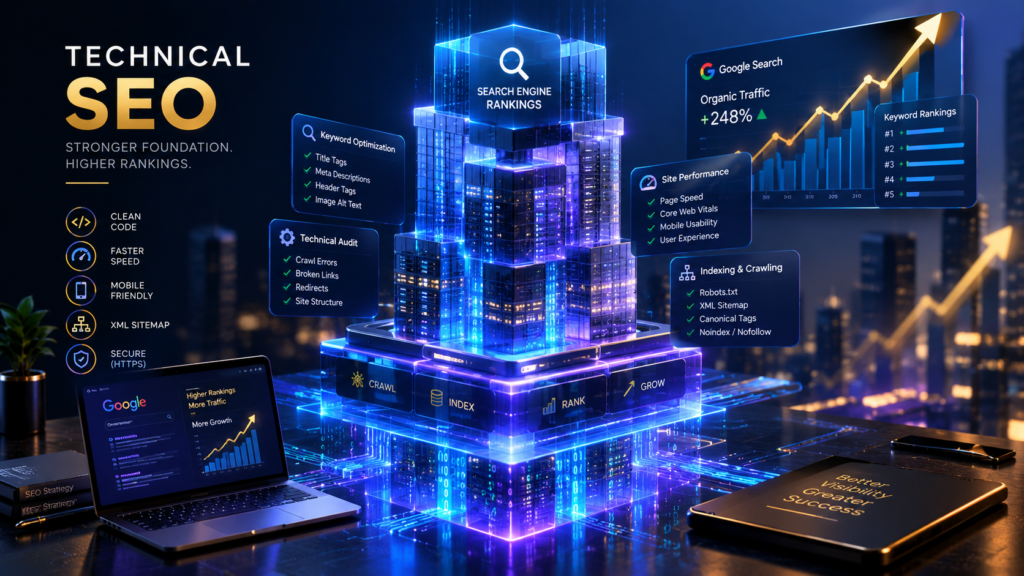
In the fast-paced world of digital marketing, many brands rush straight toward keyword targeting, content writing, and aggressive link-building campaigns. While these strategies are critical components of a successful search presence, executing them on a broken technical foundation is a massive waste of resources.
Think of your website as a skyscraper: content and backlinks are the floors and aesthetic architecture, but Technical SEO is the concrete foundation. If the foundation is weak, the entire structure will eventually collapse under search algorithm updates.
What Exactly is Technical SEO?
Technical SEO refers to the process of optimizing your website’s infrastructure so that search engine crawlers (like Googlebot) can easily access, crawl, interpret, and index your pages. It has less to do with the actual words written on a page and everything to do with what happens behind the scenes.
If search engines cannot smoothly navigate your website, they will not rank your high-quality content, no matter how well it is written.
Core Pillars of a Solid Technical Foundation
To ensure your website is engineered to win, you must audit and continuous optimize these four fundamental technical elements:
1. Page Speed and Core Web Vitals
User experience is a major ranking signal. A slow-loading website frustrates users and forces them to click away, which signals to Google that your site might not be high quality. Optimizing your code, utilizing modern image formats (like WebP), leveraging browser caching, and minimizing heavy JavaScript executions are critical to passing Google’s strict Core Web Vitals assessment.
2. Crawlability and Indexation Management
Search engines use “crawlers” to read your website. If your site has setup errors in the robots.txt file, or incorrect ‘noindex’ tags, you might be accidentally blocking search engines from seeing your most important landing pages. Properly managing your XML sitemap and fixing 404 (broken) links ensures crawlers spend their valuable budget efficiently on your site.
3. Clean Site Architecture & Internal Linking
A confusing website layout disorients both human visitors and web crawlers. Your site structure should follow a logical hierarchy where every critical page is accessible within 3 clicks from the homepage. Strategic internal linking distributes link equity (ranking power) across your domain and clarifies the relationship between different topics to search engines.
4. Secure Protocols (HTTPS)
Security is non-negotiable. Websites still running on old HTTP protocols are flagged as “Not Secure” by modern web browsers. Transitioning to an SSL-encrypted HTTPS connection protects visitor data and serves as a fundamental trust factor for both clients and modern search engines.
Conclusion: Build First, Outsource Next
Before investing thousands of dollars into outbound guest posting and digital PR campaigns, ensure your inner loop is flawless. Fix your site errors, speed up your page loads, and organize your structural framework. Once your Technical SEO is rock solid, every authority-driven link you build will multiply in value and deliver lasting, compounding organic growth.