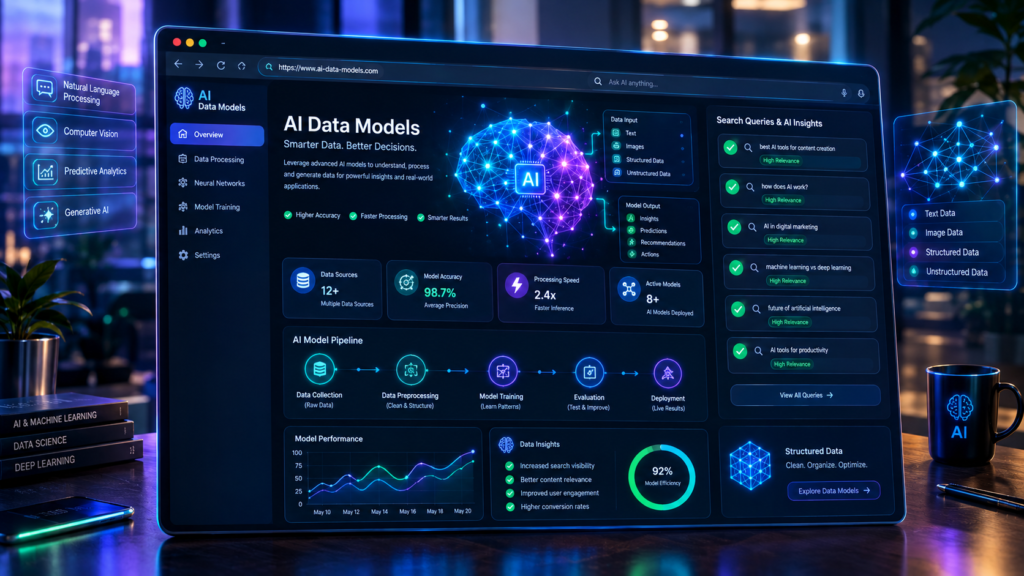
The landscape of search engine optimization is undergoing its most significant transformation since the launch of mobile-first indexing. With Google fully integrating AI Overviews (formerly SGE) directly into search result pages, securing a traditional “blue link” position on page one is no longer the ultimate prize.
Today, brands must focus on optimization models that place their insights directly inside the AI-generated response snapshot. If your website isn’t being cited by Google’s LLM (Large Language Model), you risk losing a massive share of your organic click-through rate.
Understanding how AI Summaries Gather Data
Google’s AI engine does not just look for matching keywords; it attempts to understand the topical authority, context, and factual accuracy of an entire webpage. The model scans index repositories in real-time to synthesize a concise, structured answer for the user.
To become the primary source that the AI quotes, your content must transition from generic keyword stuffing to high-density, authoritative answers.
3 Critical Strategies to Win the AI Overview Snippet
To protect your organic traffic and adapt to the future of AI search, you must implement these advanced optimization layers across your domain:
1. Implement Strict Structured Data and Schema
AI search agents rely heavily on explicit structural clues to map connections between entities. By utilizing advanced Schema Markup (such as Article, FAQ, and Product Schema), you provide search engine bots with a clean, machine-readable dataset. The easier it is for an AI algorithm to parse your data types, the higher your chances of being featured as a cited source.
2. Focus on “Information Gain” and Unique Insights
Google’s algorithms are increasingly punishing conversational content that merely rehashes existing internet articles. To rank in AI models, you must introduce “Information Gain”—this means publishing original case studies, proprietary statistics, unique charts, or direct quotes from senior industry experts. AI summary bots prioritize indexing unique datasets that provide genuine value.
3. Answer Long-Tail Conversational Queries Directly
With voice search and conversational AI on the rise, search queries are becoming much longer and more specific. Instead of targeting short phrases like “SEO services,” structure your landing pages to answer exact multi-sentence questions, such as: “How does a B2B SaaS startup calculate the ROI of an outreach link-building campaign?” Write clear, programmatic headers (H2 and H3 tags) followed by immediate, 2-3 sentence authoritative answers.
Conclusion: The New Era of Visibility
AI Overviews are not an SEO killer; they are a filter that separates basic content farms from true topical authorities. By restructuring your site’s technical data frameworks and dedicating resources to premium, asset-driven content, your domain will emerge as a trusted source for both human searchers and next-generation artificial intelligence models.